
Kundalini: The Serpent Ascends
“As Ananta, the Lord of Serpents, upholds the earth, so Kundalini is the support of all Yogic practices." — Hatha Yoga Pradipika
JUNE 2026
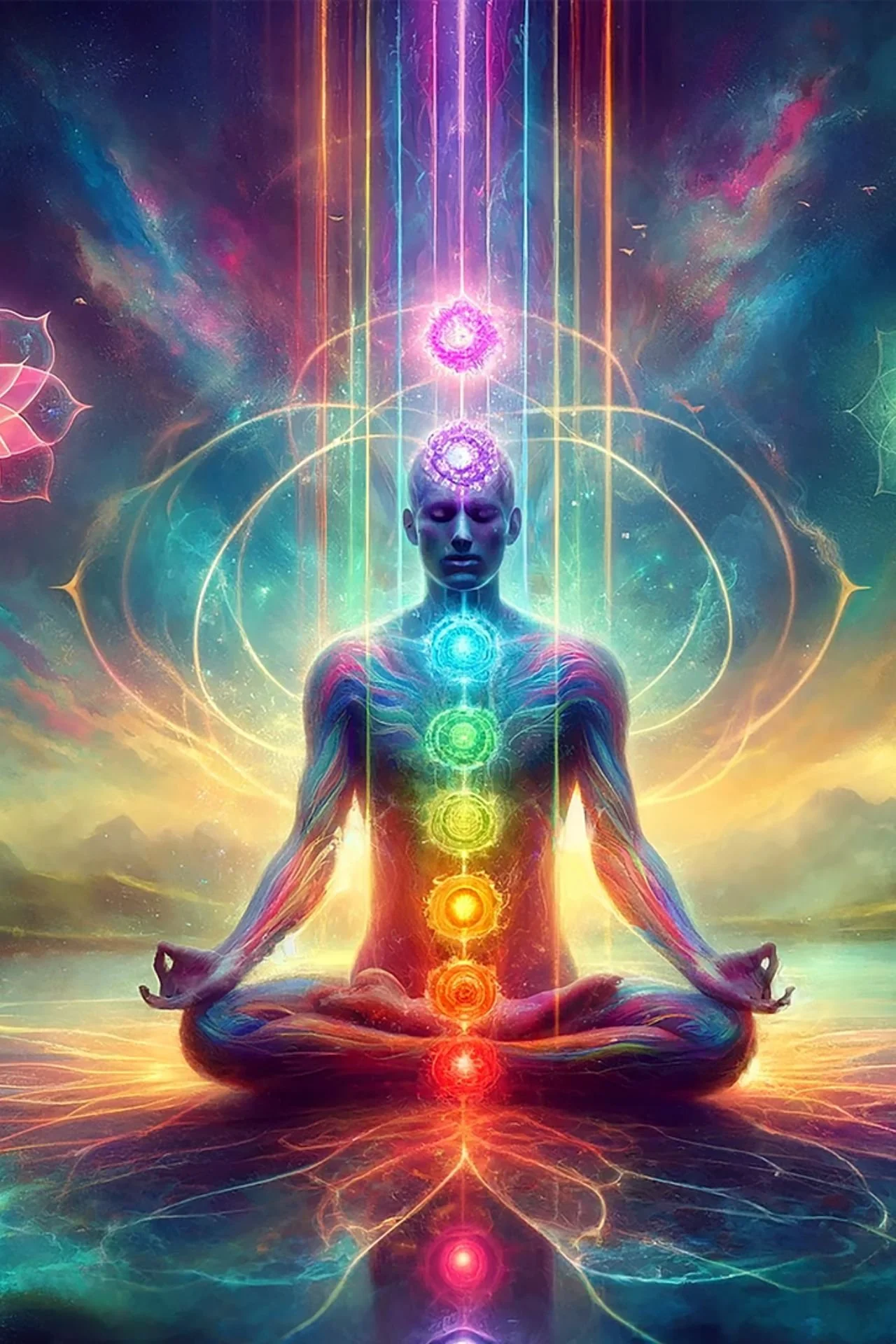
An Ancient Map of Awakening Energy
There are seasons on this path where a particular energy starts making itself known before you fully understand why. For me, it's been starting in the base chakra, moving up into the heart chakra and quite literally rumbling like a steam locomotive. It's not fully expressed, as I can still feel restriction, but it's starting to move. As I sit with what this means, I’ve been tracing back the history of the kundalini energy and what the ancients knew about this system.
So let's explore the ancient architecture of the body it moves through, the union it's said to be working toward, and what I'm coming to understand as I sit with my own awakening to it.
What Kundalini Actually Is
Kundalini comes from the Sanskrit kundalin, meaning "coiled." In the classical Tantric and Hatha Yoga traditions of India, she is described as Shakti — the divine feminine creative force, lying dormant at the base of the spine, coiled like a sleeping serpent around the entrance to the body's central channel.
The most detailed instructions on her come from the Hatha Yoga Pradipika, a fifteenth-century Sanskrit manual written by the yogi Svatmarama, and from the Sat-Cakra-Nirupana, the text that gave the Western world its modern understanding of the chakra system. These are centuries-old texts, written for practitioners walking alongside a teacher, and they describe in detail how this energy is said to move and what it does along the way.
Kundalini, in this original framing, is not simply "energy" in the vague sense we often hear the word being used today. She is Shakti herself — feminine, creative, generative, waiting to rise and unite with Shiva, the still, consciousness-principle, said to reside at the crown of the head. The entire kundalini process, in its classical form, is the journey of that union.
The Central Channel: Sushumna, Ida and Pingala
To understand what kundalini does, it helps to understand the energetic architecture she is said to move through.
Running through the centre of the body is the sushumna nadi — the central channel, understood as the spine's subtle counterpart. Flanking it are two other channels: ida on the left, associated with lunar, feminine, cooling energy, and pingala on the right, associated with solar, masculine, heating energy. In ordinary waking life, prana or life force, is understood to move primarily through ida and pingala, alternating and rarely balanced. The classical teaching is that when these two are brought into equilibrium, the way opens for kundalini to rise through the central sushumna channel instead.
The image of two currents winding around a central staff looks a lot like the caduceus of Greek mythology, the staff of Hermes. There's no evidence these two traditions ever crossed paths as they arose an ocean and centuries apart, and yet the imagery echoes so closely it's hard to ignore. Part of that may be the body itself: every human being lives inside a symmetrical form, two sides of a single spine, in-breath and out-breath, sun and moon, masculine and feminine, yin and yang, and any culture paying close attention to its own felt experience may naturally arrive at the same shape. But I don't think one explanation cancels out the other. When I find resonance across ancient wisdom traditions, I take it as a signpost — a reminder that the body's own architecture and the deeper truths it's pointing to aren't separate things, but two sides of the same coin. Science can tell us why the shape repeats. Spirit tells us why it matters.
What Kundalini Activates: The Three Knots
The Hatha Yoga Pradipika doesn't describe kundalini's rise as a single, instant event. It describes a piercing of three granthis — psychic knots or blockages, that must be opened in sequence as she ascends:
The Brahma Granthi, at the base of the sushumna, the muladhara, or root chakra — associated with our attachment to the physical and material world.
The Vishnu Granthi, at the heart — anahata — associated with emotional attachment and the bonds of relationship and identity.
The Rudra Granthi, near the third eye — ajna — associated with the final dissolving of ego-identity itself.
Only once kundalini has pierced all three and reached the crown chakra, sahasrara, does the text describe the release of amrita, the nectar of immortality, flooding back down through the body. Stirring at the root-centre is described in the classical model as the very beginning of this process, not the union itself. The union happens at the top of the arc, not the bottom.
It's also worth being noting that this piercing isn't always described as gentle. The texts themselves treat it as intense, sometimes disorienting work, restriction, pressure, heat, and resistance are part of the process, not a sign that something has gone wrong. This is exactly why the Hatha Yoga Pradipika repeatedly insists these practices are not meant to be done alone. Svatmarama cautions that they should be kept secret and practised only under the direct guidance of a guru. That's not an old-world formality, it reflects a real, practical understanding that this energy can move through the body in ways that are difficult to navigate without support.
Modern transpersonal psychology has its own name for what can happen when this comes online in a system that isn't prepared for it: psychiatrist Stanislav Grof called it a "spiritual emergency" — a state where an awakening process outpaces a person's capacity to stay grounded, and what should be expansive can tip into genuine disorientation, confusion, or a destabilising loss of one's usual footing in reality. If you feel this energy stirring in your own body and want to explore it further, I’d recommend finding a practitioner or teacher experienced in this specific work, rather than trying to move it alone.
The Marriage of Masculine and Feminine
This is where kundalini's real meaning comes into focus. The rising of Shakti through the sushumna toward union with Shiva at the crown is, at its heart, an internal marriage, the divine feminine and divine masculine, both already present within the one body, moving toward integration. In the non-dual Tantric view, this isn't a poetic metaphor layered on top of biology. It is described as the actual mechanism of spiritual awakening: consciousness (Shiva) and creative energy (Shakti) recognising each other, held for so long apart by the everyday distractions of ida and pingala, finally meeting as one.
It's a genuinely different model to the way we tend to speak about "divine feminine energy" now, as something separate that we call in or connect with. In this original framework, she was never elsewhere. She has been coiled at the base the entire time, waiting to be recognised rather than invited.
Musing in Summary
Kundalini is a carefully documented current. A coiled feminine intelligence at the base of the body, that rises through the central channel, moving through knot after knot, toward union with the stillness at the crown.
There is an incredibly powerful energy already living within us that most of us, especially in the West, were simply never taught to notice, let alone work with. We grow up fluent in the language of the mind and the muscular body, and almost entirely illiterate in the language of our own energetic architecture. Kundalini, however you name her, is the tradition's way of saying that dormant is not the same as absent. She's not something we need to import from outside ourselves. She's already there, waiting.
What she's said to unlock, when she rises, isn't a party trick or a bliss-state to chase for its own sake. It's connection to the divine as something felt rather than believed. It's the self-healing capacity of the body finally being given the current to work with. It's creator energy, the same generative force that makes life, made available to us as consciousness, insight, and creative expression rather than only as biology. Root to crown, ida to pingala, feminine to masculine: I don't think these are separate systems politely nodding at each other. I think they're one continuous field, describing the same, singular, source intelligence from wherever each tradition happened to be standing when it looked.
"Shakti creates Maya to make Shiva visible; the female principle builds reality." — Carl Jung
References:
Svatmarama, Hatha Yoga Pradipika (15th century)
Sir John Woodroffe, The Serpent Power: Sat-Cakra-Nirupana translated
C.G. Jung, The Psychology of Kundalini Yoga
Georg Feuerstein, The Shambhala Encyclopedia of Yoga
Stanislav Grof & Christina Grof, Spiritual Emergency: When Personal Transformation Becomes a Crisis