
Qi Gong: An Ancient River With Two Banks
“Qi follows Yi; Yi follows Xin." (Energy follows intention; intention follows the heart-mind) — traditional Qi Gong saying
JUNE 2026
History, Martial Roots & the Turn Toward Healing
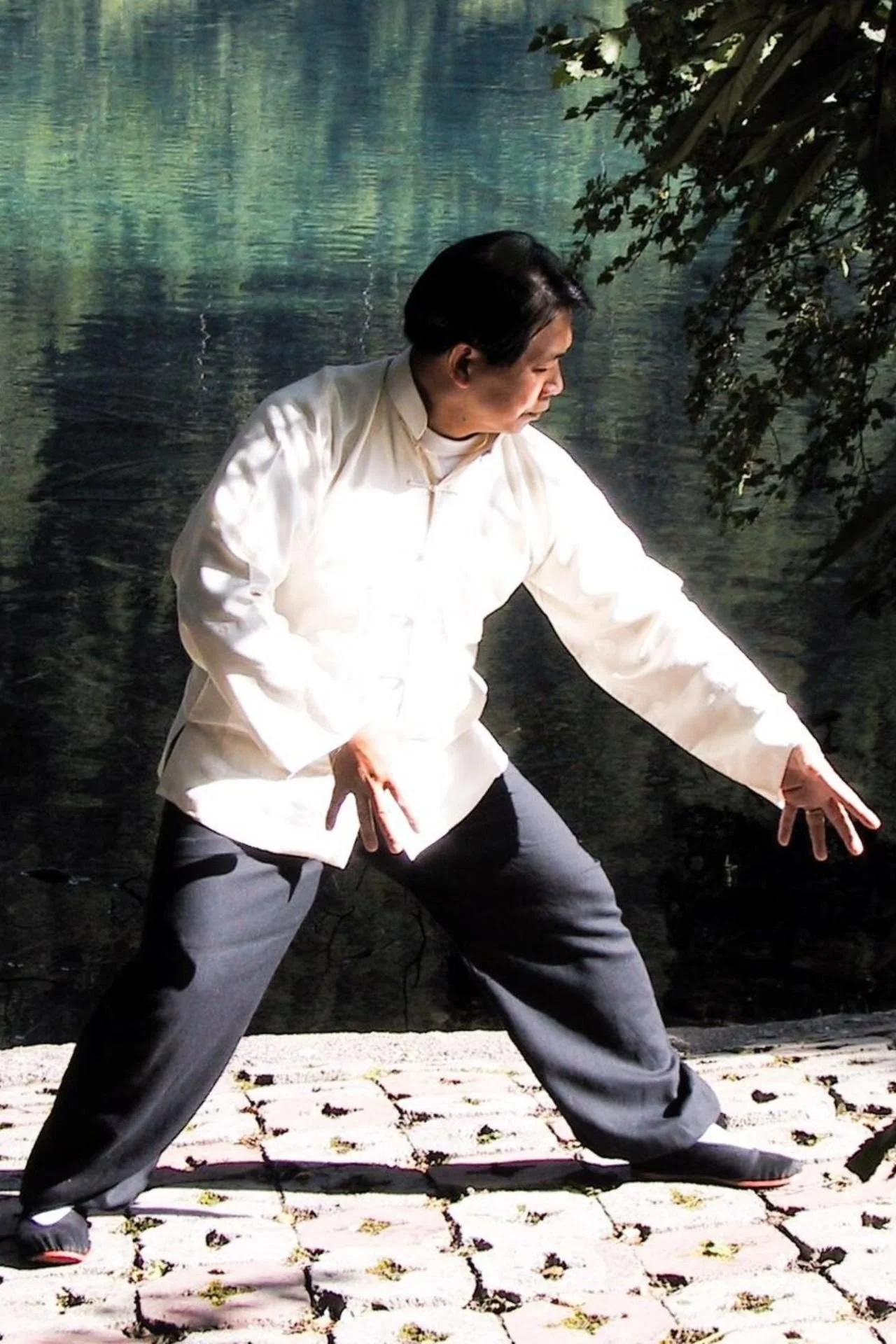
I recently attended a Qi Gong healing retreat that has left my whole system quieter, clearer, and more spacious than when I left. I sat at the feet of two extraordinary teachers; Master Dennis Wang from Singapore and Master Yap Boh Heung from Malaysia, and what I learned from them both, has stayed with me in a way I knew I needed to write about before it settled too far into the background of daily life.
This isn't a technique post. It's a musing on where the practice of Qi Gong comes from, why it exists in two forms that can look almost unrelated to each other, and what it meant to watch two masters who have spent forty and fifty years respectively in these lineages arrive, each in their own time, at healing as the place their energy wanted to go.
What is Qi Gong?
Qi Gong (气功) is usually translated simply as energy work or breath work. Qi being vital energy or life force and Gong being skill cultivated through steady practice. But that simple translation hides just how vast and varied the tradition actually is. It isn't one system, it's closer to a river fed by many tributaries; shamanic ritual, Daoist internal alchemy, Buddhist meditation, and centuries of Chinese medical theory, all moving toward the same aim: working consciously with the energy that animates the body, rather than leaving it to run on autopilot.
What struck me most on retreat was that underneath the different forms; martial, medical, spiritual, the raw material is the same. What differs is what a lineage, or a particular master, chooses to do with it.
From Shamans to Scholars: Roots Reaching Back Over Four Thousand Years
The earliest traces of what would become Qi Gong are thought to reach back to Neolithic China, to shamans whose dances, often mimicking the movements of animals were used to enter trance states, communicate with the spirit world, and heal the sick. Archaeological evidence from as early as the Shang dynasty (roughly 1600–1046 BCE) points to breathwork and meditative movement already being used for healing and spiritual connection.
Over time these ritual dances settled into something more systematic: daoyin (guiding and pulling), a practice of gentle stretching and breath combined with visualisation, and xingqi (circulating qi), the deliberate movement of energy through the body. Physicians such as Hua Tuo, working around the second century CE, developed the famous "Five Animal Frolics", a set of exercises modelled on the tiger, deer, bear, monkey and crane explicitly to regulate the flow of qi and support long-term health. This is really the birth of what we would now call medical Qi Gong: a tool prescribed by physicians alongside herbal medicine and acupuncture, sometimes as the primary treatment itself.
As Buddhism arrived from India, it brought yogic and pranayama traditions that merged with existing Daoist practice, particularly through the Shaolin Temple, where legend credits the monk Bodhidharma with teaching monks movement practices to withstand long hours of seated meditation. From there, over the Tang and Song dynasties and beyond, Qi Gong threads itself through Confucian ideas of self-cultivation, Daoist longevity practice, and Buddhist mind-training, gradually branching into the many hundreds of styles that exist under the Qi Gong umbrella today.
Two Threads: The Martial Path and the Healing Path
It's here that the two banks of the river become visible. As Chinese martial arts developed at Shaolin, at Wudang, and in countless regional schools, practitioners adapted Qi Gong theory to sharpen their fighting ability: internal power, rooted stances, breath timed to strikes. This is martial Qi Gong, the lineage that underlies the internal power of Tai Chi, Bagua, and Southern Shaolin systems.
Alongside it, medical Qi Gong continued to develop as its own discipline, often practised by the very same people. Many renowned Traditional Chinese Medicine physicians were also Qi Gong masters, and it was not unusual for an advanced practitioner to use emitted qi, sent from their own body into a patient's energy field, as part of treatment. Two threads, one river — sometimes running in the same person at the same time.
This is exactly the pattern I watched play out, in the two teachers I had the privilege of learning from.
Meeting My Teachers: Master Dennis Wang and Master Yap Boh Heung
Master Yap Boh Heung has spent over forty years in traditional Southern Shaolin martial arts, trained originally by his father, a celebrated grandmaster, in the internal art of Wu Mei Quan. For years his focus was squarely martial; precision, power, the fighting application of internal energy. It was only later in his path that his attention turned toward health and wellbeing, and toward the fascia and myofascial structures of the body as the medium through which qi moves and can be cleared. This shift from combat application to healing application of the exact same internal skill is a complete reorientation of what the energy is for.
Master Dennis Wang came to this work by a different road. He began his working life as a banker, then became a successful businessman running his own companies, and it was on trips through the mountains of China, taken in his down time, that he found his master. That teacher was Grandmaster Shao Xing Xuen, and in 2003 Master Dennis began studying his system, Han Yang Ru Yi, a form of medical Qi Gong. In 2010 he was accepted as Grandmaster Shao's first indoor disciple (those expected to carry the lineage forward and trusted to teach or pass on the system), and from there his practice deepened into Wai Qi Liao Fa, the external transmission of qi as a therapeutic method, which he now teaches around the world.
Sitting with both of them across the retreat, I could feel this living history weaving into the room.
Opening the Channel, Then Healing: From Myofascial Meridians to Medical Qi Gong
Master Yap taught us to work directly with the myofascial meridians, the fascial lines that wrap and connect the body from head to toe, distinct from (although related to) the classical acupuncture meridians of Traditional Chinese Medicine. Fascia is the body's great connective web, and Master Yap's approach treats it as the terrain qi travels across. Clearing this field meant learning to draw energy up from the earth and down from the universe, letting it move through the internal system rather than treating the body as a fixed, separate object to be worked on from outside. While our body can store and charge energy through the lower dantian, our vessel is a channel that energy is meant to pass through — earth below, sky above, and us, standing in the middle, as the meeting point.
Once our energy system was clear and running, Master Dennis introduced the protocols he has spent over two decades developing, using this energy specifically for healing. Learning within that framework, from clearing and energising, to applying the healing techniques, made the ancient structure of the tradition land in a really practical way.
Musing in Summary
What I keep returning to, days after leaving the retreat, is how the history of Qi Gong is really a history of a single question asked over and over across thousands of years: now that I can feel and move this energy, what do I want to do with it? For centuries, in different hands, the answer has swung between protection and healing — sometimes both, in the very same person, at different points along their path.
Spending time with Master Yap Boh Heung and Master Dennis Wang gave me a living, breathing version of that same arc. With decades of dedicated practice, each of them arriving, in their own time, at healing as the place their qi wanted, or perhaps needed to go. I feel incredibly honoured to have learned from them, to feel their energy, zest and commitment to sharing knowledge, and to know this is just the beginning of a deepening of my own healing practice.
"The way to do is to be." — Lao Tzu, Tao Te Ching
References:
Taoist Sanctuary of San Diego, History of Qi Gong
Energy Arts, Qigong History
Healthful Qigong, Several Millennia of Qigong History
YSG-Qigong.org, Yan Shou Gong
The Martial Camp / The Martial Man,